In class we've begun exploring the world of ethics and its relation to the world of professional occupations. In light of the topic, we read the New York Times article describing a psychological experiment conducted by Facebook. In this study, Facebook manipulated the visible content of hundreds of thousands of users, changing their news feed to reflect more positive or negative content. The goal of this study was apparently to see how emotions can spread through social media and how this affects social media usage. The controversy over the study was that Facebook did not request any addition consent, using their far-reaching user agreement as a legal blanket to justify their actions.
I believe that the actions of Facebook were ethically questionable, siding on the wrong side of the sliding scale. While Facebook does make it fairly clear that you've given away most if not all of your rights when agreeing to the user agreement, I think that conducting manipulative experiments on people without their knowledge and explicit consent is wrong. I base this view off of the school of thought which justifies actions by their virtue. In our society, honesty is regarded as virtuous and honest, transparent, reviewed research procedures are the ethical norm. If such a study was done in a university in the same manner, it would be thrown out the window along with a few key staff members. What Facebook did was, by societies standard of virtue, dishonest and against virtue. If Facebook ever hopes to command respect with their research, they ought to follow the guidelines set out by whichever research body lies in the country of study: The American Psychological Association in this instance. While I may imply that Facebook should be "following the rules" as per the deontologicalists, I in fact only mean to say they should be following these rules due to their basis in virtue and ethical norms.
Fun fact, data collection is the most efficient it's ever been. Here's an article on how Target's marketing research actually tipped a family off on a pregnancy. Time to whip out that "real" paper journal: Big Brother is watching.
http://www.forbes.com/sites/kashmirhill/2012/02/16/how-target-figured-out-a-teen-girl-was-pregnant-before-her-father-did/#432e6d834c62
Goel, V. (2014, June 29). Facebook Tinkers with Users' Emotions in News Feed Experiment Stirring Outcry. New York Times. Retrieved from http://www.nytimes.com/2014/06/30/technology/facebook-tinkers-with-users-emotions-in-news-feed-experiment-stirring-outcry.html?_r=0
Friday, October 28, 2016

Wednesday, October 26, 2016
You don't understand! - I do! I do!
The the video "I Know Nothing!-Faulty Towers-BBC", there is an obvious failure in communication between two people. The man on the left wishes for the man who is presumably his butler to act as though he knows nothing about a certain horse. The butler, however, believes the man is talking down to him; saying he "knows nothing"; and strings the conversation along under that pretext.
In this scenario there are many barriers to communication. The first is a semantic, connotative barrier where the man selects words that could be understood differently in a different context: "You know nothing". This could also categorize as a cultural barrier to communication as, in our culture, that phrase implies something in the way of: "Please act like you know nothing about whatever is about to be spoken of, I need to keep a secret"; whereas, the butler's understanding of this from his linguistic ability and culture, the phrase means "You are ignorant". This understanding leads into the next barrier which is psychological in nature; the butler becomes defensive and less responsive to the man. Further on in the video, there is another barrier erected as the man uses ambiguous word choice which is not understood by the butler: "The horse", "Which horse?". Also, the English colloquial term "nit wit" is understood by the butler to be the name of the horse, while, in fact, he is the one being referenced as a nit wit. Lastly, the butler continues to misunderstand the mans desire to command as various statements of fact when the man says "forget about the horse". Overall, we can see in a rather dramatic fashion that there are certain patterns of speech which aid or completely halt the process of communication.
References
Mishra, Sneha. (2016). Models of communication. Retrieved from:
https://www.businesstopia.net/communication on Oct. 26 2016
In this scenario there are many barriers to communication. The first is a semantic, connotative barrier where the man selects words that could be understood differently in a different context: "You know nothing". This could also categorize as a cultural barrier to communication as, in our culture, that phrase implies something in the way of: "Please act like you know nothing about whatever is about to be spoken of, I need to keep a secret"; whereas, the butler's understanding of this from his linguistic ability and culture, the phrase means "You are ignorant". This understanding leads into the next barrier which is psychological in nature; the butler becomes defensive and less responsive to the man. Further on in the video, there is another barrier erected as the man uses ambiguous word choice which is not understood by the butler: "The horse", "Which horse?". Also, the English colloquial term "nit wit" is understood by the butler to be the name of the horse, while, in fact, he is the one being referenced as a nit wit. Lastly, the butler continues to misunderstand the mans desire to command as various statements of fact when the man says "forget about the horse". Overall, we can see in a rather dramatic fashion that there are certain patterns of speech which aid or completely halt the process of communication.
References
Mishra, Sneha. (2016). Models of communication. Retrieved from:
https://www.businesstopia.net/communication on Oct. 26 2016
Monday, October 24, 2016
Situational Leadership in Groups
Just as appropriate leadership style is reflective of factors specific to an activity, there are also considerations as to how to lead a group during the five stages of group development (Tuckman model).
Forming
Directing leadership is the style that serves the group best while they're first meeting and working together. My reasoning is that in the beginning, the group is not only unfamiliar with the routines associate with their tasks but also more focused on getting to know one another. On the groups' side, there is a lower task focus and a higher relationship focus; having a leader to keep the group on track will help accomplish the required goals and not take away from the overall experience.
Storming
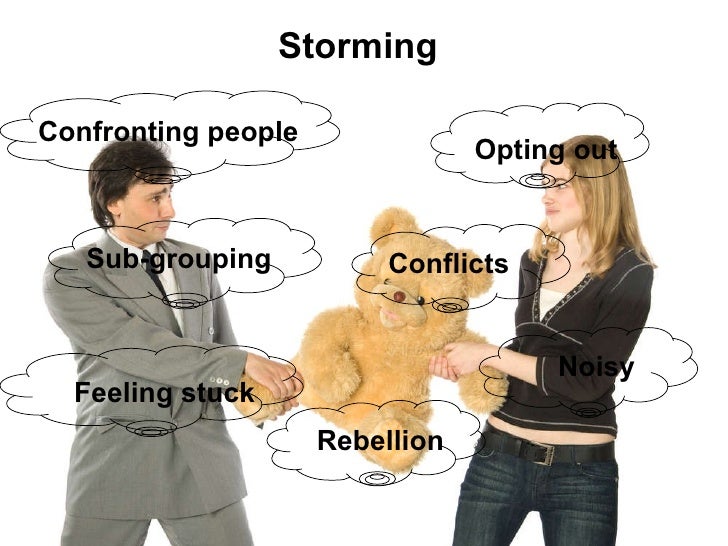
The storming stage necessitates a participatory and selling approach in leading. Since this stage is, in essence, the group dealing with interpersonal difficulties, avoiding a rigid structure of leadership allows the members to come to understandings without force. While it's still necessary to focus on the goals of the group, they have at this point gained some experience and can be included in decisions.
Norming
While "norming", the group is finding what works well in the group dynamic and utilizing these realizations. During this time there's still room for new issues to emerge and old issues to be better handled. Given the uncertainty, I believe the most suitable leadership style in this stage is continuing participating; this will allow the group to secure their effective habits.
Performing
When the group is performing, they're being most effective as a unit. Now that the group is what we would consider competent, or mostly competent, the leader can delegate and allow other to make decisions within reason. There is no need for a more controlling style of leadership.

Adjourning
As the group comes to the end of their time together they once again enter into tasks and routines that are dissimilar to what their used to. In order to keep things on track, I believe directing to be the most appropriate.
Forming
Directing leadership is the style that serves the group best while they're first meeting and working together. My reasoning is that in the beginning, the group is not only unfamiliar with the routines associate with their tasks but also more focused on getting to know one another. On the groups' side, there is a lower task focus and a higher relationship focus; having a leader to keep the group on track will help accomplish the required goals and not take away from the overall experience.
Storming
The storming stage necessitates a participatory and selling approach in leading. Since this stage is, in essence, the group dealing with interpersonal difficulties, avoiding a rigid structure of leadership allows the members to come to understandings without force. While it's still necessary to focus on the goals of the group, they have at this point gained some experience and can be included in decisions.
Norming
While "norming", the group is finding what works well in the group dynamic and utilizing these realizations. During this time there's still room for new issues to emerge and old issues to be better handled. Given the uncertainty, I believe the most suitable leadership style in this stage is continuing participating; this will allow the group to secure their effective habits.
Performing
When the group is performing, they're being most effective as a unit. Now that the group is what we would consider competent, or mostly competent, the leader can delegate and allow other to make decisions within reason. There is no need for a more controlling style of leadership.
Adjourning
As the group comes to the end of their time together they once again enter into tasks and routines that are dissimilar to what their used to. In order to keep things on track, I believe directing to be the most appropriate.
Friday, October 7, 2016
Who am I?
This week we're taking a look at ourselves in order to function better as students and team members. I completed a quiz on "multiple intelligences" on literacynet.org.
My results were:
1. Self (4.71)
2. Body Movement (4.29)
3. Language (3.86)
This was no real surprise; really, I think it's quite accurate. I have a tendency to be self-aware by default and think things over probably more than is good for me. As for body movement, I've always been well-coordinated and have picked up sports relatively quickly. Language also fits the mold, although I'm better with written language than verbal as it isn't socially acceptable to speak in monologues; I enjoy reading and learn from what I've read.
I also completed two Myers Briggs personality assessments from:
humanmetrics.com
personalitypathways.com
I scored as an INTP on both tests. I (Introverted) N (Intuition) T (Thinking) P (Perceiving)
I think that the INTP label is an accurate description of my personality. I find thinking of situations that confirm my quiz findings difficult because it would require me to sift through thousands of instances. I've often been in arguments where the actual format of the argument is being debated. I've had plenty of moments where people may interpret me as being "in my own world"; they would be right. I have, in the past for the most part, second guessed myself more than is reasonable. Overall, it's easy for me to agree that I can be slotted into this group.
Suggested careers for my personality type are largely centered around the sciences. The careers listed on humanmetrics included: natural science, natural science education, information systems, computer science, software engineering, and being a librarian. These suggestions are quite unfortunate as they were part of the reason I pursued a scientific education before enrolling at Algonquin College. Science, in general, seemed like an obvious choice as I'm good at it, it pays well, and the demands of the work seem to match my personality. In truth, although I enjoyed the actual science, I found the lifestyle of academia to be unrewarding and tedious, leading me here to the more adventurous side of the Ottawa valley.
My results were:
1. Self (4.71)
2. Body Movement (4.29)
3. Language (3.86)
This was no real surprise; really, I think it's quite accurate. I have a tendency to be self-aware by default and think things over probably more than is good for me. As for body movement, I've always been well-coordinated and have picked up sports relatively quickly. Language also fits the mold, although I'm better with written language than verbal as it isn't socially acceptable to speak in monologues; I enjoy reading and learn from what I've read.
I also completed two Myers Briggs personality assessments from:
humanmetrics.com
personalitypathways.com
I scored as an INTP on both tests. I (Introverted) N (Intuition) T (Thinking) P (Perceiving)
I think that the INTP label is an accurate description of my personality. I find thinking of situations that confirm my quiz findings difficult because it would require me to sift through thousands of instances. I've often been in arguments where the actual format of the argument is being debated. I've had plenty of moments where people may interpret me as being "in my own world"; they would be right. I have, in the past for the most part, second guessed myself more than is reasonable. Overall, it's easy for me to agree that I can be slotted into this group.
Suggested careers for my personality type are largely centered around the sciences. The careers listed on humanmetrics included: natural science, natural science education, information systems, computer science, software engineering, and being a librarian. These suggestions are quite unfortunate as they were part of the reason I pursued a scientific education before enrolling at Algonquin College. Science, in general, seemed like an obvious choice as I'm good at it, it pays well, and the demands of the work seem to match my personality. In truth, although I enjoyed the actual science, I found the lifestyle of academia to be unrewarding and tedious, leading me here to the more adventurous side of the Ottawa valley.
Row Row Row your Raft
Finishing off the month of September in the Outdoor Adventure program we were privileged to spend 6 days rafting in Quebec. Moving from the Gatineau to the Rouge and finally to the Jacques Cartier, we developed our skills in raft guiding, camp-craft, and swift-water rescue.
My favorite part of the trip is a tough tie between guiding our raft on the technical rapids of the Jacques and viewing the near-perfectly clear stars at our valley campground in Stoneham-et-Tewkesbury, QC. While I find the power of big volume rapids exciting, the execution is boring without any technicality. This made the rocky channels of the Jacques my favorite; if you weren't on your toes, you were pinned.
While not a major bummer, my least favorite part of the trip was trying to guess the intentions of the course coordinators. Often the timing of meetings or events were vague and almost hidden from the group. Usually, in order to be on time, I would need to ask at least five people about details to get a sense as to what was expected of us, not always successfully. I also learned that putting on wet neoprene gloves near freezing temperatures will give me some of the worst pain I've ever experienced: I rate that experience 0/10, I will not do that again.
When I think about the professionalism of our instructors I think there is some value in my inability to think of examples. In my opinion, the only things that are obvious to a neutral observer are amazing professionalism and poor professionalism. Our instructors kept a semi-regular format including morning and post-trip briefing, maintained safety, and gave us the opportunity to be well-fed and geared up. However, I did not enjoy the lack of clear cut communication; it is easiest to be well organized when you know how much time you have to do any given task.

My favorite part of the trip is a tough tie between guiding our raft on the technical rapids of the Jacques and viewing the near-perfectly clear stars at our valley campground in Stoneham-et-Tewkesbury, QC. While I find the power of big volume rapids exciting, the execution is boring without any technicality. This made the rocky channels of the Jacques my favorite; if you weren't on your toes, you were pinned.
While not a major bummer, my least favorite part of the trip was trying to guess the intentions of the course coordinators. Often the timing of meetings or events were vague and almost hidden from the group. Usually, in order to be on time, I would need to ask at least five people about details to get a sense as to what was expected of us, not always successfully. I also learned that putting on wet neoprene gloves near freezing temperatures will give me some of the worst pain I've ever experienced: I rate that experience 0/10, I will not do that again.
When I think about the professionalism of our instructors I think there is some value in my inability to think of examples. In my opinion, the only things that are obvious to a neutral observer are amazing professionalism and poor professionalism. Our instructors kept a semi-regular format including morning and post-trip briefing, maintained safety, and gave us the opportunity to be well-fed and geared up. However, I did not enjoy the lack of clear cut communication; it is easiest to be well organized when you know how much time you have to do any given task.

My rafting group with our guide: Seth Ashworth
Subscribe to:
Comments (Atom)